
Tree work for Rock Hill and York County
Tree Removal in Rock Hill, SC
Tall pines over roofs, rotting water oaks, split Bradford pears and storm wreckage, taken down safely and hauled away.
- On-site quotes at no charge in Rock Hill and York County
- Prices put in writing before the crew arrives
- Cleanup terms written into the estimate
Taking Down Trees in the Carolina Piedmont
Tree removal in Rock Hill usually starts with one of two things: a storm that has already done damage, or a homeowner who looks up at a 70-foot pine leaning toward the bedroom and decides not to wait for the next one. Rock Hill sits in the Piedmont about 25 miles south of Charlotte, on red clay, with a mix of pines, oaks, sweetgums and ornamental trees that grow fast in the heat and humidity. Fast growth is part of the problem. Many of the trees we take down here were planted or left standing when a subdivision went in, and twenty or thirty years later they are far bigger than the yard they live in.
Storms are the main reason trees come down here
Rock Hill does not get many hurricanes head-on, but it gets their leftovers and plenty of its own weather. Hurricane Hugo tracked up I-77 toward Rock Hill in September 1989 with winds over 90 mph, toppling large oaks and pines across York County. In February 2004 about 22 inches of snow fell across the region and knocked out power for days. On April 20, 2024, the National Weather Service traced a swath of 60 to 90 mph straight-line winds through the city, with hail up to four inches across, and about 200 homes were damaged. In January 2026 an ice storm warning called for a quarter to four-tenths of an inch of ice. Each kind of storm breaks trees differently: wind snaps tall pines and uproots trees in wet clay, while ice and wet snow pile weight onto long limbs until they tear out.
The trees that cause the most trouble
Loblolly pine is everywhere in Rock Hill yards. It is a good tree in a woodlot, but in a backyard it grows tall and top-heavy, with most of its weight high in the crown, and it can snap or lift out of saturated ground in a hard wind. Water oak is another common one. Clemson Extension notes that its wood is weaker than most oaks, it is prone to wind, snow and ice damage, and its trunks often begin to rot by about 50 years of age. Bradford pears, planted by the thousands along streets and in front yards, have tight forks that split in storms. South Carolina banned the sale of Bradford and other Callery pears starting October 1, 2024, though the rule does not require anyone to take existing trees out. Emerald ash borer has also been found in York County, so ash trees that are thinning from the top are worth a closer look.
Red clay, wet ground and tight lots
The soils across this part of the Piedmont are mostly well-drained sandy loam over red clay subsoil. Clay holds water after long rains and gets hard as brick in a dry August. Roots in compacted clay around new homes stay shallow, and a tree that lost roots when the foundation, driveway or sewer line went in can stand for years before it starts to decline. That is why so many removals here are in subdivisions where trees were left standing during construction: they were stressed from the start and are now big enough to reach the house.
City rules worth knowing
Rock Hill's tree ordinance covers public trees, meaning street trees in the right-of-way and trees on city property. Removing, pruning or treating one of those needs a permit from the city forester, and the city expects that work to follow the ANSI A300 pruning standard. A tree entirely on your own lot is generally your call, but if the removal is part of a building or development project, the zoning ordinance protects large heritage trees and may require replacement planting, so check with Planning and Development first. The city also expects private trees to be kept trimmed at least 8 feet over sidewalks and 14 feet over streets. And the city does not pick up debris from tree removal at the curb, so every quote we write includes what happens to the wood.
What a quote from us includes
- Every tree listed separately with the method: felled whole, taken down in sections, or lifted out by crane
- What stays and what goes: logs, firewood rounds, chips and brush
- Whether the stump is ground, and how deep
- Anything the crew needs from you, such as moving cars or opening a gate
- One price for the work you approve
What We Do
Six kinds of work cover nearly every tree job on a Rock Hill property, from a single cracked limb to a pine that needs a crane.
Tree Removal
Unwanted, overgrown and declining trees taken down whole or in sections, with every log and branch accounted for.
Learn more →Emergency & Storm Tree Removal
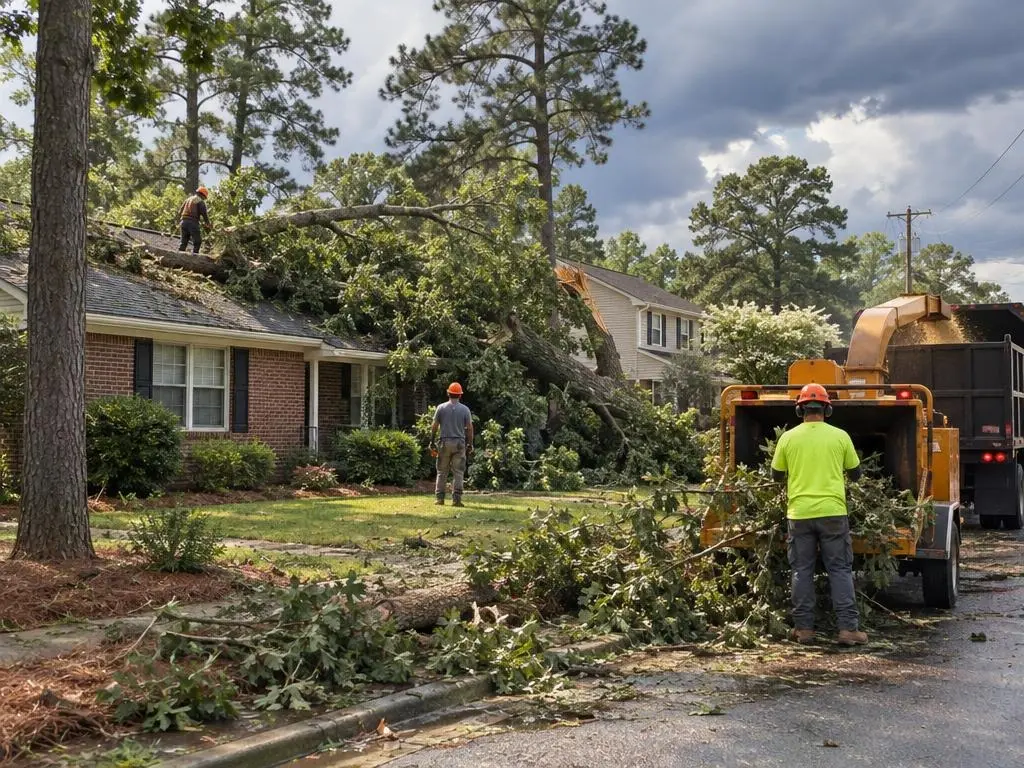
Trees on roofs, cars, fences and driveways after thunderstorms, ice and hurricane remnants, handled by order of danger.
Learn more →Crane-Assisted Tree Removal
Big pines and oaks over houses, pools and fenced backyards lifted out in sections when there is no safe place to drop them.
Learn more →Dead & Hazard Tree Removal
Dead pines, rotting water oaks, ash killed by borers and cracked trees taken down before they fail.
Learn more →Tree Trimming & Pruning
Limbs cut back from roofs and wires, deadwood removed and crowns thinned to the ANSI A300 standard.
Learn more →Stump Grinding
Stumps ground below the surface so you can replant, sod or mow over the spot.
Learn more →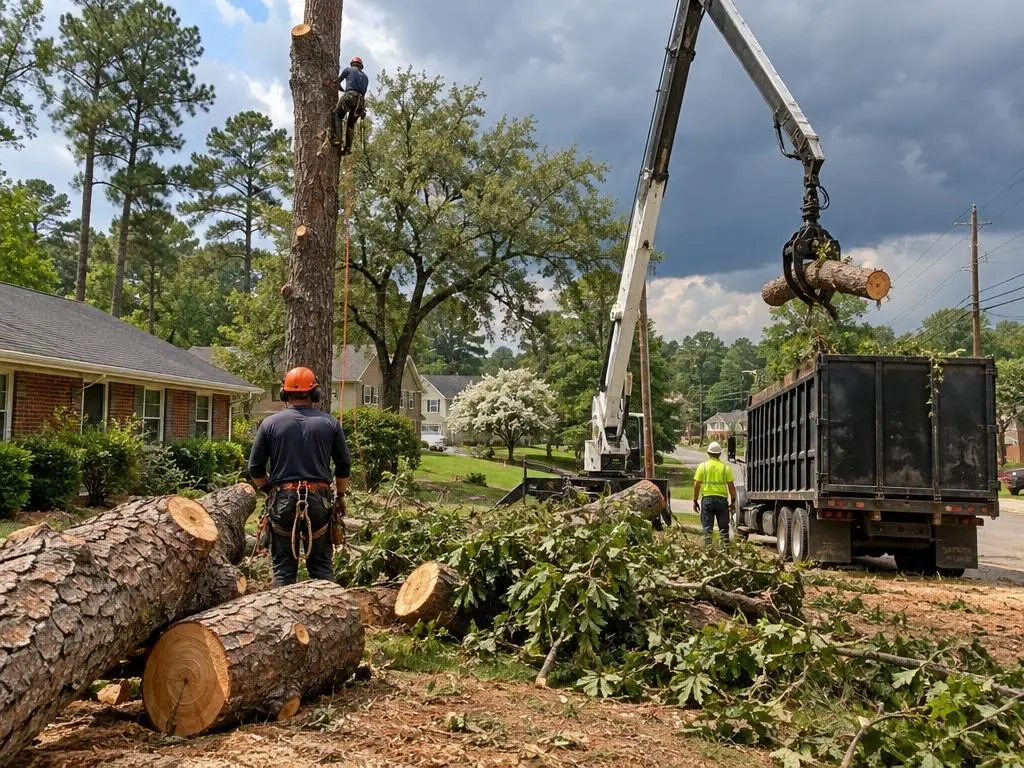
Why Homeowners Call Tree Removal Rock Hill
We price at the tree
Pines over roofs, hollow water oaks and trees behind fences can't be priced fairly from a phone call, so every quote comes from a visit.
Haul-off is never an afterthought
Rock Hill does not take tree removal debris at the curb, so the quote states exactly what leaves the property and what stays.
We check whose tree it is
Street trees, trees on a property line and trees near primary wires are sorted out before any price, so you don't pay for work you can't legally order.
We work around clay and lawns
Wet red clay ruts easily, so we plan where equipment goes and protect the ground on the way in and out.
Where We Work
Rock Hill is home base. We work across the city, from the historic blocks around Oakland Avenue and Winthrop to the subdivisions of Ebenezer, Newport and Oakdale, and out into the rest of York County and the edges of Lancaster and Chester counties. Fort Mill and Tega Cay to the north have newer neighborhoods with HOA rules and lots that back onto wooded common areas. Lake Wylie properties often have steep, wooded slopes running down to the water, where access decides how a tree comes down. York, Clover, Catawba and the rural roads toward Chester have more acreage, more pines, and more trees growing along fence lines and fields. If you are not sure whether we cover your address, call and ask.
- Tree Removal in Rock Hill, SC
- Tree Removal in Fort Mill, SC
- Tree Removal in Tega Cay, SC
- Tree Removal in Lake Wylie, SC
- Tree Removal in India Hook, SC
- Tree Removal in Newport, SC
- Tree Removal in Lesslie, SC
- Tree Removal in Catawba, SC
- Tree Removal in York, SC
- Tree Removal in Clover, SC
- Tree Removal in Indian Land, SC
- Tree Removal in Van Wyck, SC
- Tree Removal in Lancaster, SC
- Tree Removal in Chester, SC
- Tree Removal in Charlotte, NC
- Tree Removal in Ballantyne, NC
- Tree Removal in Pineville, NC
- Tree Removal in Matthews, NC
- Tree Removal in Weddington, NC
- Tree Removal in Marvin, NC
- Tree Removal in Waxhaw, NC
- Tree Removal in Belmont, NC
- Tree Removal in Gastonia, NC
Common Questions
How much does tree removal cost in Rock Hill?
This Old House's Rock Hill guide puts a typical removal between about $247 and $1,086, with an average near $507, and emergency removals around $1,300. National 2026 guides from Angi and HomeGuide put most removals between $200 and $2,000, with large trees over 80 feet higher. Height, lean, what is under the tree and whether it is dead all move the price. Your written estimate is the price.
Do I need a permit to cut down a tree in my yard in Rock Hill?
For a tree entirely on your own residential lot, the city's tree ordinance generally does not require a permit. Street trees and trees on city property are public trees, and removing or pruning them needs a permit from the city forester. If the removal is part of construction or development, ask Planning and Development about the heritage tree rules first. HOAs in many Rock Hill subdivisions also have their own approval process, so check your covenants.
Who removes a tree that is touching a power line?
Trees in contact with a primary line belong to the electric provider, so call the number on your power bill and stay at least 10 feet away. For the service drop that runs from the pole to your house, Duke Energy, for example, will turn off the line at no cost so a tree crew can work safely. We will not cut a tree that is in contact with an energized line.
Will the city pick up the limbs and logs after a tree is removed?
No. Rock Hill's rules say debris from a large tree removal or land clearing is not collected at the curb, and limbs over 12 feet long or 6 inches thick need a special pickup even from routine yard work. That is why hauling is written into our quotes. If you want to keep firewood or chips, we leave them where you ask.
Is there a tree removal company near me that handles storm damage?
Yes. If you are in Rock Hill or nearby York County and a tree has fallen on your house, car or driveway, call (803) 752-2370 any time to leave details and photos. Trees on roofs and trees blocking the only way in or out are handled first. If wires are involved, call the utility before anyone touches the tree.
Should I take down a big pine just because it is close to the house?
Not always. A healthy, well-rooted pine can stand for decades, but a pine that leans toward the house, has lost roots to construction, shows brown or fading needles, or has small pitch tubes on the bark from beetles is a different story. We look at the root zone, the lean and the crown and tell you honestly whether it needs to come out or just needs a few limbs removed.
What should I do with a Bradford pear?
Bradford pears are prone to splitting at their narrow forks, and older ones often lose half the tree in a storm. Clemson Extension runs a Bradford pear bounty that trades up to five removed pears for free native trees, with a 2027 swap scheduled in Fort Mill. We can take the tree down and grind the stump, and you can sign up for the bounty yourself.
Request Your Free Tree Removal Quote
Free on-site estimates across Rock Hill and York County.